Clinical
Cybersecurity
Framework
Cybersecurity as a living system.
The Clinical Cybersecurity Framework (CCF) reframes cybersecurity as an operational discipline built on readiness, diagnosis, intervention, recovery, and learning. Instead of measuring activity, CCF helps organizations measure readiness. Instead of reacting to incidents after the fact, CCF builds the muscle memory, intelligence, and decision discipline needed to perform under pressure.
Why Cybersecurity Must Become a Clinical Discipline
In medicine, teams do not wait for the emergency to learn. They train, rehearse, diagnose, triage, intervene, recover, and review. Cybersecurity should operate the same way. CCF is designed for organizations that want to move beyond fragmented tools, reactive operations, and compliance-only thinking toward a disciplined model of operational readiness.
Readiness
Preparing, training, and conditioning before the moment arrives. Readiness is the foundation — it cannot be improvised.
Response
Diagnosing, triaging, and acting with precision during the event. Speed and accuracy both matter. Confusion is the adversary's ally.
Review
Learning, refining, and strengthening the system after the fact. Every event is an intelligence asset. Never waste a crisis.
The Living System, Visualized
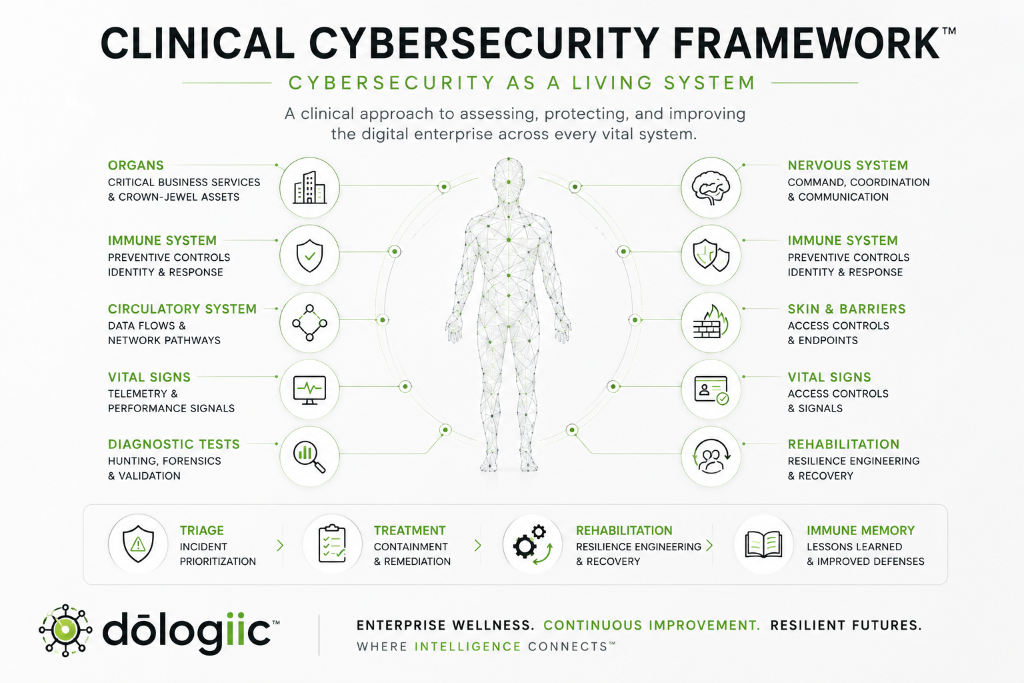
The Enterprise as a Living System
CCF uses the human body as a strategic analogy for understanding how enterprises function under stress, exposure, and attack. Every system has its analogue. Every vulnerability has its parallel.
Critical business services and crown-jewel assets
Command, coordination, communications, leadership decision paths
Preventive controls, identity, detections, segmentation, response capability
Data flows, network pathways, application dependencies
Access controls, endpoints, user boundaries, exposed surfaces
Telemetry, baselines, performance and security signals
Alerts, anomalies, degraded workflows, unusual behavior
Hunting, forensics, intelligence analysis, validation
Incident prioritization by criticality and impact
Containment, remediation, restoration
Resilience engineering, recovery testing, business reintegration
Lessons learned, improved detections, hardened controls, better playbooks
Threat intelligence sharing, sector collaboration, collective defense
The Clinical Operating Cycle
CCF helps organizations understand what normal looks like, recognize meaningful deviation, prioritize impact, intervene quickly, recover fully, and build institutional memory from every event.
CCF Readiness Assessment
Rate your organization across the 8 stages of the Clinical Operating Cycle and receive a personalized readiness score with targeted next steps.
How It Works
You'll rate your organization on a scale of 1–5 across each of the 8 CCF Operating Cycle stages. Takes about 3 minutes. You'll receive a readiness score and specific, actionable guidance for your lowest-scoring areas.
CCF 2026 Is Live at
ccf.dologiic.com
The full CCF platform is now live — including the Cyber Wellness Score, interactive assessments, subscription resources, learning paths, advisory services, and the 10 Clinical Domains framework.
From Activity
to Readiness
Download the Executive White Paper
Get the foundational overview of the Clinical Cybersecurity Framework, including the living system model, the operating cycle, and the leadership implications for resilience, governance, and executive decision-making.
The Book in Development
CCF is being developed into a full-length book that expands the framework into leadership guidance, implementation methods, maturity modeling, training approaches, and operational discipline for modern organizations.
Join the Book Waitlist
Be the first to know when CCF launches as a full framework guide.
Research & Insights
Authoritative perspectives on cybersecurity maturity, AI governance, cyber resilience, and organizational wellness — published at ccf.dologiic.com
Why Your CISO Needs a Clinical Mindset, Not Just a Security Checklist
Mapping Your Enterprise's Digital Anatomy: Organs, Circulation, and Immune Systems
AI Is an Accelerant. Without Governance, It's Also a Liability.
What Boards Actually Need to Know About Cyber Risk in 2026
CCF White Papers
Free research publications from the CCF Institute
CCF White Paper — Version 1
The foundational framework: treating the enterprise as a living digital organism. Clinical Operating Cycle, living system model, leadership implications.
Download Free PDFAI Cyber Policy Under the CCF
Governing AI as the Enterprise Cognitive-Nervous System. 10 policy domains, AI Cyber Wellness Index, 90-day roadmap, board reporting templates.
Download Free PDFFinancial Exposure & ROI Calculator
Translate cyber risk into financial terms. Adjust the variables to estimate your Annual Loss Expectancy (ALE) and the projected return on security investment.
Annual Loss Expectancy
Projected Control ROI
ROI = (Loss Avoided − Investment) ÷ Investment. A positive return indicates the control pays for itself in risk reduction. Estimates are illustrative, based on a simplified FAIR model.
Bring CCF Into
Your Organization
For leadership teams seeking a practical operational model for readiness, resilience, and executive cyber decision-making, dōlogiic offers CCF briefings, workshops, and advisory support.